
If you live in the United States and keep a bank account, brokerage account or pension in another country, the end of the year is the right moment to check two reports: the FBAR and Form 8938. The FBAR filing requirements are simple on paper, but they catch many people by surprise, because the duty to report has nothing to do with whether the account earned income or whether you owe any tax. This guide explains who must file, the dollar thresholds, the deadlines and the penalties, and what to do if you have missed a year.
TaxWise Advisors prepares these reports for individuals and small businesses in Charlotte, Monroe and the surrounding towns, and for clients across the United States, in English and in Russian. The rules below are taken from the IRS and FinCEN pages linked in the text. If you would rather talk it through than read, call us at (980) 980-4829 or book a consultation.
Two reports, two agencies
The FBAR and Form 8938 look alike, and many people assume that filing one covers the other. It does not.
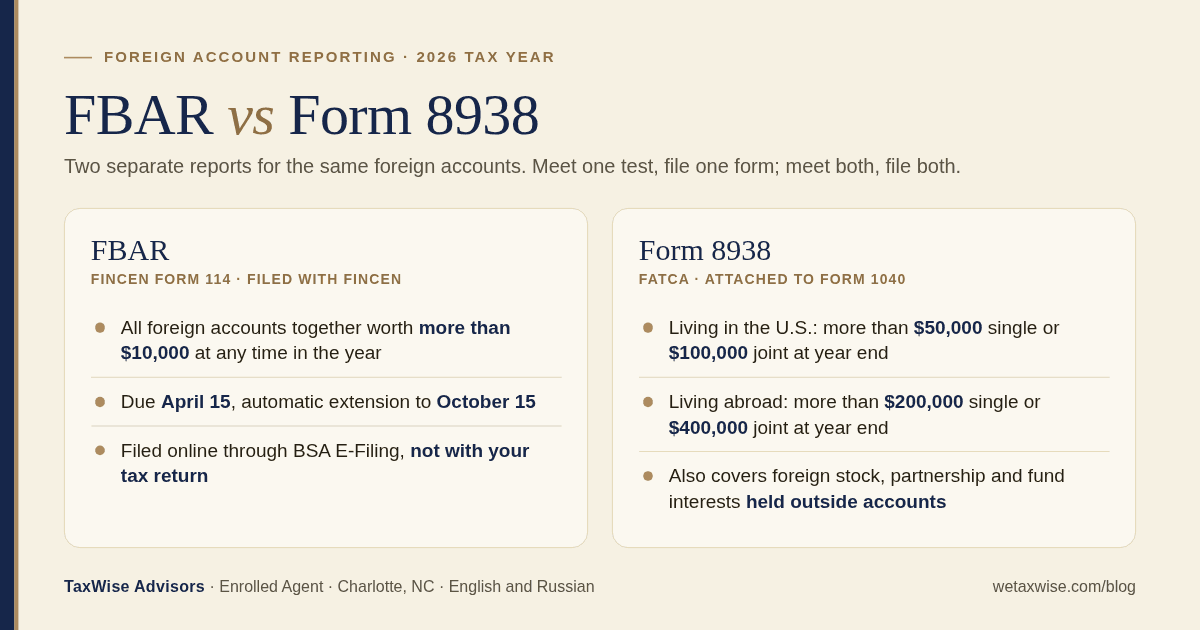
- FBAR stands for Report of Foreign Bank and Financial Accounts. The form is FinCEN Form 114. It goes to the Financial Crimes Enforcement Network (FinCEN), a bureau of the U.S. Treasury, and it is not filed with your federal tax return.
- Form 8938, Statement of Specified Foreign Financial Assets, is an IRS form created by the Foreign Account Tax Compliance Act (FATCA). You attach it to your annual income tax return.
The IRS states it plainly: Form 8938 does not relieve filers of FBAR filing requirements. If an account meets both tests, you report it twice, once on each form.
FBAR filing requirements: the $10,000 test
A U.S. person must file an FBAR when two conditions are met:
- You had a financial interest in, or signature or other authority over, at least one financial account located outside the United States.
- The aggregate value of all those foreign accounts exceeded $10,000 at any time during the calendar year.
"U.S. person" is broad. According to the IRS, it includes a citizen, a resident, a corporation, a partnership, a limited liability company, a trust and an estate. Green card holders and people who meet the substantial presence test are residents for this purpose, even if they consider their real home to be abroad.
Three details trip people up:
- The threshold is aggregate, not per account. If you had $4,000 in one account and $7,000 in another, the total of $11,000 means you must file and report both accounts, even though neither account alone exceeded $10,000. The IRS reference guide, Publication 5569, walks through this exact situation.
- "At any time" means the peak, not the year-end balance. An account that held $12,000 for one week in March and $500 on December 31 still counts.
- Income is irrelevant. The same publication gives the example of an account that produces no income at all; the FBAR is still due.
Signature authority matters too. If you can direct payments from a foreign account that belongs to a relative or an employer, that account belongs on your FBAR, subject to exceptions, even though the money is not yours. Accounts at a foreign branch of a U.S. bank are also reportable on the FBAR. One common exclusion: accounts held in a retirement plan of which you are a participant or beneficiary do not have to be reported.
When and how the FBAR is filed
The FBAR is an annual report, due April 15 following the calendar year reported. For accounts you held in 2026, that means April 15, 2027.
If you miss April 15, you get an automatic extension to October 15. You do not need to request it, and no form is required. In practice this makes October 15 the real deadline, but there is no reason to wait: the report is short once the account statements are in hand.
The FBAR is filed electronically through FinCEN's BSA E-Filing System. A tax professional can file it on your behalf with a signed authorization. Keep the records behind the report, such as account statements showing the maximum value, for five years from the due date of the FBAR.
Form 8938: higher thresholds, wider net
Form 8938 applies to "specified foreign financial assets," a category that is wider than bank accounts. Its thresholds are much higher than the FBAR's, so a family with a modest savings account abroad often needs the FBAR and nothing more. The threshold depends on two things: whether you live in the United States and whether you file a joint return with your spouse. The figures come from the IRS comparison table:
- You live in the U.S. and file as single, head of household or married filing separately: file if your foreign assets were worth more than $50,000 on the last day of the year, or more than $75,000 at any point during the year.
- You live in the U.S. and file jointly with your spouse: the limits double, to $100,000 at year end or $150,000 at any point during the year.
- You live abroad: the limits are $200,000 at year end or $300,000 during the year for a single filer, and $400,000 or $600,000 for a joint return.
So a married couple in Charlotte with $60,000 in foreign accounts files an FBAR (the total is over $10,000) but not Form 8938 (the total is under $100,000). The same couple with $120,000 files both.
Form 8938 is attached to your income tax return and is due when the return is due, including extensions. If you file Form 1040 in April, Form 8938 goes with it; if you extend the return to October, Form 8938 is extended with it.
What goes on which form
The two forms overlap on foreign bank and brokerage accounts, but each covers things the other does not. In short: the FBAR is about accounts, including ones you merely have signature authority over, while Form 8938 also reaches investments you hold directly, outside any account. Neither form asks about a house or apartment you own abroad. The table is a simplified version of the IRS comparison; if you are not sure where an asset belongs, get in touch and we will sort it with you.
| Asset | Form 8938 | FBAR |
|---|---|---|
| Accounts at a foreign bank or broker | Yes | Yes |
| Foreign mutual funds | Yes | Yes |
| Foreign stock or securities held directly, not in an account | Yes | No |
| Interest in a foreign partnership | Yes | No |
| Foreign hedge funds and private equity funds | Yes | No |
| Account you only have signature authority over | No, unless you also have an interest in it | Yes, subject to exceptions |
| Account at a foreign branch of a U.S. bank | No | Yes |
| Foreign real estate held directly | No | No |
| Foreign currency held directly (cash) | No | No |
A typical example from Charlotte-area families: a couple who moved from abroad keeps a savings account in their home country, a brokerage account with a foreign broker and shares in a family company held in their own names. The savings and brokerage accounts go on both forms if the thresholds are met. The directly held shares go on Form 8938 only. An apartment they still own abroad goes on neither, although rent from it is taxable income on the U.S. return.
Penalties: what the law actually says
The FBAR penalty rules are the reason this report deserves attention. Under Title 31 of the U.S. Code, the statutory ceilings are up to $10,000 per non-willful violation and, for a willful violation, up to the greater of $100,000 or 50 percent of the account balance. Those ceilings are adjusted for inflation every year, so the current maximums are higher than the base figures; the adjusted amounts are published in the penalty table at 31 CFR 1010.821. Criminal penalties may apply in willful cases: Publication 5569 lists up to $250,000 or five years in prison, or both, for failure to file an FBAR or keep the required records.
Two points from the same publication soften the picture for ordinary taxpayers. The penalties are maximums with no minimum, so the IRS has discretion. And if you properly report the account on a late FBAR and the IRS determines the failure was due to reasonable cause, no penalty is imposed.
For Form 8938, the IRS comparison table gives a penalty of up to $10,000 for failure to disclose, plus an additional $10,000 for each 30 days of non-filing after the IRS sends a notice, up to a maximum of $60,000. Because Form 8938 is part of the tax return, a missing form can also keep the statute of limitations open on the return itself.
Missed a year? Your options
Discovering an old foreign account that was never reported is common, especially after an inheritance or a move. The right path depends on whether tax was also underreported and on how the failure happened.
You reported all the income, but never filed the FBAR. The IRS guidance for this case is direct: if the IRS has not contacted you about a late FBAR and you are not under civil or criminal investigation, file the late FBARs as soon as possible to keep potential penalties to a minimum. The online FinCEN Form 114 lets you select the year being reported and gives a text box to explain the late filing.
You also left foreign income off your returns, and it was not deliberate. The Streamlined Filing Compliance Procedures exist for exactly this case. You must certify that the conduct was non-willful, file amended or original returns for the most recent three years, and file FBARs for the most recent six years.
- For taxpayers living in the United States, the program charges a single "Title 26 miscellaneous offshore penalty" equal to 5 percent of the highest aggregate balance of the unreported assets during the period covered, in place of the regular FBAR and information-return penalties.
- For taxpayers living outside the United States who were physically outside the country for at least 330 full days in one of the three years, the same filings carry no failure-to-file, failure-to-pay, accuracy-related, information-return or FBAR penalties, unless an examination later finds the original non-compliance was fraudulent or willful.
The failure may have been willful. Streamlined is not available in that case, and filing a streamlined certification that turns out to be false creates new problems. This is a situation to discuss with a licensed representative before anything is filed. An Enrolled Agent can represent you before the IRS on penalty notices and examinations.
A year-end checklist for foreign accounts
By December 31 you will know whether 2026 crossed the thresholds. A short review now saves a scramble in April:
- List every foreign account you own, own jointly, or can sign on: bank, savings, brokerage, investment-linked insurance, business accounts of a company you control, and accounts of parents or children where you are a signatory.
- Find the highest balance of each account during the year, not the year-end figure. Online banking histories usually show it; otherwise request annual statements now, while the bank's support lines are quiet.
- Add the peaks together. Over $10,000 in total means an FBAR for 2026. Then check your total against the Form 8938 threshold that matches your filing status and residence.
- Note assets held outside accounts: directly held foreign shares, partnership interests, foreign pensions and life insurance with cash value. They may belong on Form 8938 even if they never appear on an FBAR.
- Make sure everyone in the household who files has a taxpayer number. A spouse or dependent without a Social Security number needs an ITIN before a joint return with Form 8938 can be filed.
- Check prior years. If an account existed in 2025 or earlier and was never reported, decide on the catch-up route described above before filing the 2026 forms, so the late reports and the current one tell a consistent story.
How TaxWise Advisors can help
Foreign account reporting is part of the firm's international tax services: identifying which accounts and assets are reportable, converting balances to U.S. dollars, preparing and e-filing the FBAR, and attaching Form 8938 to a complete federal and state tax return. For prior years, the firm prepares the late FBARs and streamlined submissions and, as an Enrolled Agent, Alina Savchuk can speak to the IRS on your behalf if a penalty notice arrives.
Fees depend on the number of accounts and years involved. Call us at (980) 980-4829 or schedule a consultation for a quote; appointments are available in English and in Russian, in person in the Charlotte area or online for clients in other states.
This article is general information based on IRS and FinCEN guidance current as of November 2026. It is not legal or tax advice for your specific situation; thresholds and penalty amounts change, so confirm the current figures with your tax professional before filing.

Alina Savchuk, EA, Founder | Enrolled Agent. Enrolled Agent and IRS Certified Acceptance Agent, TaxWise Advisors, Charlotte, NC. About the firm