
Picture a fairly ordinary April in Charlotte. You finish your return, or you open a letter from the IRS, and the balance due is a number you cannot cover this month. Maybe a side business did better than expected and nobody made estimated payments. Maybe a 1099 arrived that you had forgotten about. Whatever the cause, the question is the same: what happens now, and is there a way to pay this over time without the IRS coming after your bank account?
There is, and it is more routine than most people expect. An IRS payment plan does not shrink the debt, but it stops the collection letters, keeps the IRS from levying your wages or accounts while you pay, and cuts one of the penalties in half. This guide walks through the two kinds of plans, who qualifies, what the setup fees are in 2026, why the balance keeps growing while you pay, and when a plan is the wrong tool and something else fits better.
TaxWise Advisors sets up and negotiates these arrangements for individuals and small businesses in Charlotte, Monroe and the surrounding towns, and for clients in other states, in English and in Russian. Every figure below comes from the IRS pages linked in the text. If you would rather talk it through than read, call (980) 980-4829 or book a consultation.
Two kinds of IRS payment plan, and the only real difference is time
The IRS offers two kinds of plans, and the choice between them comes down to how long you need.
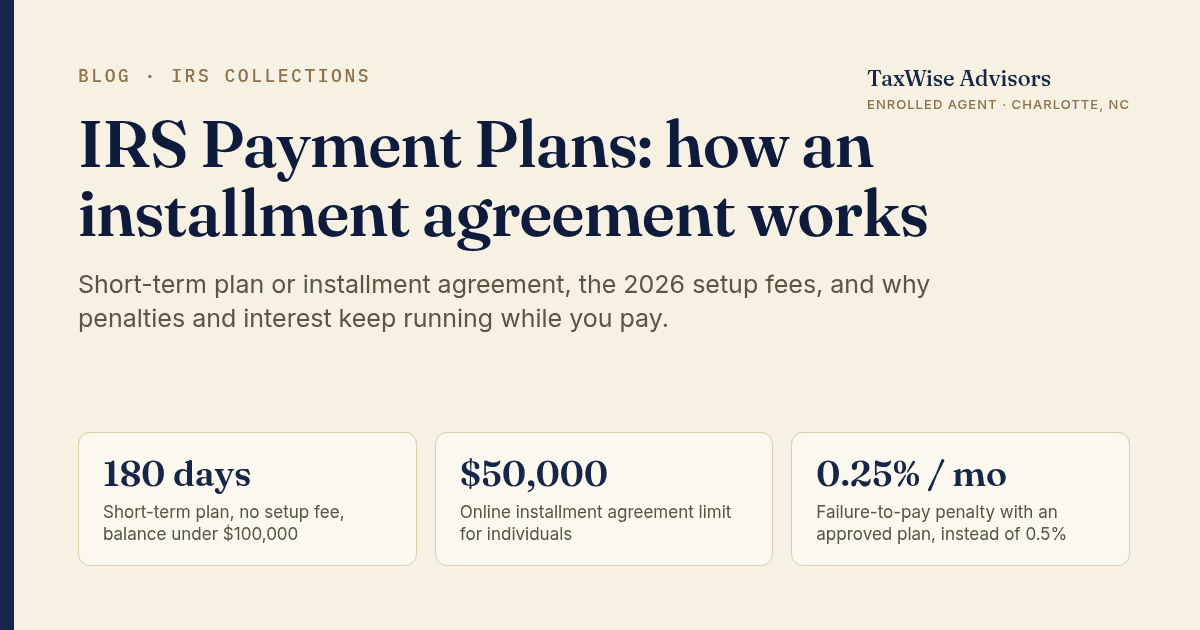
If you can clear the balance within 180 days, you want the short-term plan. It is open to individuals who owe less than $100,000 in combined tax, penalties and interest, and the IRS charges nothing to set it up. You can pay in one amount or in several, as long as the balance is gone within the 180 days. For someone who owes a few thousand dollars and expects a bonus or a tax refund from the state, this is usually the whole answer.
If you need longer, you want an installment agreement, which the IRS also calls a long-term plan. You pay a fixed amount every month for as long as it takes. Individuals can set one up online when they owe $50,000 or less in combined tax, penalties and interest and have filed every return they were supposed to file. This one has a setup fee, and we will get to the amounts in a moment.
One thing neither plan does is pause penalties or interest. Both keep accruing on whatever is still unpaid, which is why the IRS itself suggests paying as much as you can up front and picking the shortest arrangement you can realistically afford.
Who can set one up online
The fastest route is the IRS Online Payment Agreement tool. You sign in to your IRS Online Account, which means verifying your identity with a photo ID, and you see your balance and the options on the screen. For an individual the rules in 2026 are simple: $50,000 or less for a long-term plan, less than $100,000 for a short-term one, and in both cases every required return must already be filed. Approval is usually immediate.
Businesses are the exception. A business account cannot currently set up a plan through the online tool, so a company with a balance applies by phone, by mail, or through a representative.
The condition that trips people up most often is the one about returns. A missing return from two years ago blocks the plan today, even if that year's balance would have been small. And a return cannot be filed if someone on it has no taxpayer number. If your spouse or a dependent has no Social Security number, that person needs an ITIN first, then the return gets filed, and only then does the plan go through. In a household that recently moved to the United States, that order matters more than the paperwork suggests.
What if the monthly amount the online tool proposes is more than you can manage? The tool then points you to Form 9465, Installment Agreement Request, together with a Collection Information Statement, Form 433-F, which shows the IRS your income and your living expenses so a smaller payment can be justified. The same form is the route for anyone who does not fit the online limits. It can be mailed with your return or with the notice you received.
What it costs to set up
The IRS updated its fee schedule on March 3, 2026. For a long-term plan the fee depends on two things: how you apply, and whether the payments come out of your bank account by direct debit.
Apply online and let the IRS draft your account, and the fee is $29. Apply online but pay some other way, and it is $69. Apply by phone, by mail or in person with direct debit, and it is $107; the same application without direct debit is $178. The short-term plan is free however you apply.
Direct debit is cheaper for a reason. It is the payment method the IRS trusts most, because the money arrives on the same day every month without anyone having to remember, so missed payments and defaults are rare. If you can live with the automatic withdrawal, it saves money twice: on the fee now and on avoided default later.
Low-income taxpayers pay less. If your adjusted gross income is at or below 250% of the federal poverty level, the fee for a direct debit plan is waived entirely. If you pick another payment method, you pay $43, and the IRS gives it back when the plan is completed, provided you file Form 13844 within 30 days of your acceptance letter.
Changing a plan later has its own small fee. Through your Online Account you can change the monthly amount or the due date, switch to direct debit, update bank details, or reinstate a plan after a default. Online that costs $6; the same change by phone, mail or in person costs $89. Changes to an existing direct debit agreement are free.
Why the balance keeps growing while you pay
This is the part that surprises people. A plan protects you from collection action, but it does not freeze the debt. Two charges keep running at the same time.
The first is the failure-to-pay penalty. The IRS charges 0.5% of the unpaid tax for each month or part of a month, up to a cap of 25% of the unpaid tax. An approved installment agreement cuts that rate in half: for an individual who filed on time and has an approved plan, the penalty drops to 0.25% a month. Ignoring the IRS does the opposite. Once the IRS has sent a notice of intent to levy and the tax is still unpaid 10 days later, the rate climbs to 1% a month.
The second is interest. The IRS charges the federal short-term rate plus 3 percentage points, compounded daily, and resets it every quarter. For the fourth quarter of 2026, October through December, the rate for individuals is 7% a year, built from a 4% federal short-term rate. Interest runs on the tax and on the penalties.
To put that in household terms: a $10,000 balance on an approved plan costs roughly $25 in failure-to-pay penalty in the first month plus about $58 in interest, before the first payment reduces the principal. The same $10,000 with no plan and a levy notice outstanding costs $100 a month in penalty alone. Setting up the plan is one of the cheapest things you can do about the debt.
Four ways to apply
Most people with a balance under the online limits simply sign in to their IRS Online Account, open the Online Payment Agreement tool, choose short-term or long-term, set the monthly amount and the day of the month, and enter bank details if they want direct debit. Ten minutes, and the acceptance appears on the screen.
If the online tool is not available to you, Form 9465 goes in the mail, with your return or with the notice, and Form 433-F attached when the instructions or the IRS ask for it. This is the usual route for businesses and for anyone above the online thresholds.
You can also call the number printed on your notice. Businesses with a balance due call the IRS business line listed on the payment plans page.
The fourth way is through a representative. An Enrolled Agent, CPA or attorney can set up and manage the arrangement for you. The representative needs either a Tax Pro Account authorization or a Form 2848 power of attorney covering every tax period with a balance. The IRS then talks to the representative directly, which helps a great deal when the balance spans several years or a notice has to be answered before anything else can happen.
Whichever route you take, keep the acceptance letter. It states the monthly amount, the due date and the conditions, and it is the document you will want if a payment is ever misapplied.
Keeping the plan alive
An installment agreement comes with three promises, and breaking any of them puts the plan in default: pay every installment on time, file every future return on time, and pay the tax on those future returns in full. For self-employed people in particular, that third promise means making estimated payments during the year, because a fresh balance next April counts as a new default even if every installment was paid.
If a plan does default, the IRS may charge a reinstatement fee and resume collection. Your Online Account lets you reinstate or revise the arrangement for the $6 online fee, so a drop in income is a reason to adjust the payment, not to stop paying. One more detail from the IRS payment plans page worth knowing: while a request for an installment agreement is pending, the time the IRS has to collect the debt is suspended. The clock does not run in your favor while you wait.
When a plan is not the right tool
A plan assumes you can pay the whole balance over time. When that is not realistic, the IRS has other procedures, and choosing the right one is where professional IRS representation earns its fee.
Offer in Compromise. An Offer in Compromise settles the debt for less than the full amount. The application costs $205 plus a first payment, unless you meet the low-income qualifications, in which case no fee or payments are due while the offer is reviewed. You can structure it as a lump sum, sending 20% of the offer with the application and paying the rest in five or fewer payments after acceptance, or as periodic payments that continue during the review. To be considered you must have filed all required returns, be current on estimated payments and not be in an open bankruptcy; an employer must also be current on federal tax deposits for the current and the two previous quarters. The IRS says plainly that it generally will not accept an offer when the debt could be paid through a plan or from equity in assets, and the fee is not refunded if the offer is rejected. Before anyone pays that fee, the IRS Offer in Compromise Pre-Qualifier gives a realistic first answer.
Currently Not Collectible status. When income only covers basic living expenses, the IRS can suspend collection entirely for a period. Penalties and interest still accrue, but no payments are required while the status lasts.
Penalty abatement. The penalties attached to a balance can sometimes be removed, for example under the IRS First Time Abate policy or for reasonable cause, which shrinks the amount a plan has to cover. This is a separate request from the plan itself, and it is often worth making first.
North Carolina wants its own plan
An IRS arrangement covers federal tax only. If you also owe North Carolina income tax, the N.C. Department of Revenue runs a separate Installment Payment Agreement program with its own rules. The state will not set one up until it has mailed you a Notice of Collection, all required returns must be filed, the payments must be drafted from a bank account, and a standard agreement is limited to 18 monthly installments. The request goes in on Form RO-1033, and the Department replies by email. For taxpayers in Charlotte, Monroe and the rest of Mecklenburg and Union counties who owe both, the two arrangements usually need to be set up side by side, with the monthly amounts sized so that both can actually be paid.
Before you call the IRS
A little preparation makes the call, or the online session, go smoothly. Know the exact balance from the notice or your Online Account, not from memory; tax, penalties and interest are listed separately. Make sure every return is filed, and if a prior year is missing, get it prepared first. Decide on a monthly amount you can keep paying for the whole term, because a plan that defaults in six months costs more than a smaller one that lasts. Have your bank details handy if you want direct debit and the lower fee. Think about next year too: new estimated payments or a withholding change keep the following April from producing a second balance. And gather your income and expense records in case the IRS asks for Form 433-F.
How TaxWise Advisors can help
As an Enrolled Agent, Alina Savchuk is licensed to represent clients before the IRS in all 50 states. The firm reviews the notice and the IRS account transcripts to confirm the balance, prepares any missing returns so the arrangement can be approved, chooses between a short-term plan, an installment agreement, an Offer in Compromise or Currently Not Collectible status, files the application and the power of attorney, and handles the IRS correspondence until the agreement is in place. Clients with foreign income or accounts sometimes find that the balance traces back to unreported foreign items, and those filings are prepared in the same engagement.
Fees depend on the number of years and the procedure involved. Call (980) 980-4829 or schedule a consultation for a quote; appointments are available in English and in Russian, in person in the Charlotte area or online for clients in other states.
This article is general information based on IRS and N.C. Department of Revenue guidance current as of November 2026. It is not legal or tax advice for your specific situation; fees, thresholds and interest rates change, so confirm the current figures with your tax professional before applying.

Alina Savchuk, EA, Founder | Enrolled Agent. Enrolled Agent and IRS Certified Acceptance Agent, TaxWise Advisors, Charlotte, NC. About the firm